
Words: Emma Sothern (Lady Alopecia)
I grew up in a small town in rural Ireland.
Back then, as exciting as the cultural melting pot got was a German exchange student.
Seeing someone in shorts was shocking enough. Headscarves were non-existent, unless you were in history class looking at photos of wrinkly grannies on the Aran Islands.
So when I started wearing a headscarf, it wasn’t something that came naturally.
After finally surrendering to a two-decade war with hair loss, involving injections, shampoos, extensions and wigs, my confidence was about as low as it could go.
Then one day, right after shaving my remaining hair off, my friends gifted me a beautiful printed silk scarf. Which I had absolutely zero idea how to tie. It was a learning curve, to say the least.
Below, I’ll share what I wish I knew then. What I’ve learned over a decade of wearing headscarves, and how to make the experience a little easier, maybe even joyful, for you.
If you’re young, you might scoff at this notion. But believe me, one day your high heels will be pushed to the back of the closet in favour of your trusty Birkenstocks.
Similarly, the most photogenic headscarf online will likely have you cursing the shop you bought it from after it’s been melting your head for two sweaty hours at your daughter’s school performance.
Bald scalps feel the world differently from those with long hair, patchy hair, or a light fuzz. Your stage of hair loss or regrowth matters, especially if you’re going through treatment and your scalp is more sensitive.
Heat is another big factor. I feel the cold a lot. Back in Ireland, my husband Andy used to fear my cold “zombie lady feet” brushing against him under the covers.
Now, living in Vietnam, I’ve learned that an overheated head is maybe even worse than a cold one. The most photogenic headscarf will likely not be the most thermally pleasing.
For me, bamboo offers the ideal temperature, but that took a long time to figure out through trial and error.
There’s a big difference between putting on a headscarf for a wedding and wearing one for everyday life.
It’s hard to find a headscarf that stays perfectly in place all the time, but you do learn which materials work better for real life.
Bamboo and cotton are far more forgiving than silk, which is beautiful but can be slippery.
Find a style that doesn’t require an advanced degree in origami to achieve. Something you could tie after an exercise class or without a mirror. It’ll reduce your stress no end if it starts slipping halfway through the day, or if your darling four-year-old decides it’s hilarious to yank it off.
And always carry a spare.
Whether your scarf gets soaked in rain, covered in sticky toddler hands or unexpectedly worn swimming, having a backup nearby makes life much easier.
Most scarf advice online won’t relate to your real life. Because while there are plenty of kind people out there talking about headscarves, how to tie them, how to wear them and how to style them, your head is your head, and your life is your life.
For instance, I live in a very hot country where motorbikes are the primary mode of transportation. I’ve never once seen a post discussing “ways to even out the hilarious tan lines around your bald head” or the “best headscarf for squeezing under a motorbike helmet”.
Nor should there be. Even in the world of niche markets, that’s probably a bit too niche.
The only way you’re going to figure out what works for you is through trial and error.

As a newbie headscarf wearer, I opted for muted colours in some kind of attempt to blend in and pretend there was nothing new to see here.
Dublin is not the sort of place where you can suddenly change up your style and quietly test it out without anyone noticing. It’s a small city. You can, and will, bump into friends, work colleagues, old boyfriends and school bullies on a comically regular basis.
Browns and dark greens were okay, but they weren’t really me. I’d always loved bright clothes. I had a whole collection of colourful woolly hats, and now I was wrapping my head in the exact opposite. Autumnal colours in midsummer.
Whatever the opposite of a glow-up is, that’s what it felt like I was doing. A glow-down. A dimming, if you will.
It wasn’t until I became more confident and more established as a headscarf wearer that I started to find my own style again.
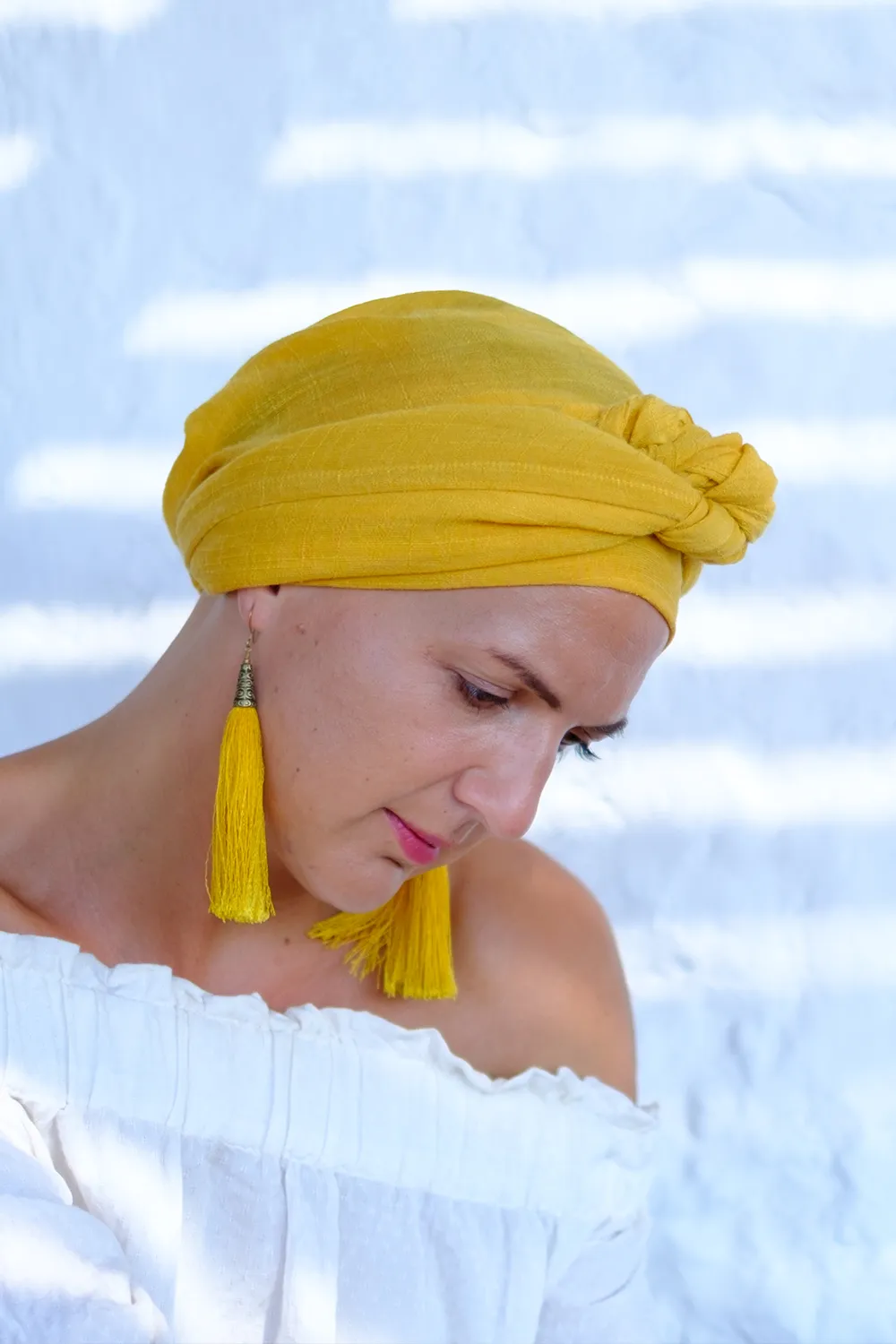
Honestly, it wasn’t really until I moved to Vietnam, to a town called Hoi An, famous for its yellow-walled Old Town, that I started dressing like myself again. If anything, my headscarves have become the brightest part of me. I frequently leave the house literally decked in yellow from head to toe.
Today I wear a headscarf almost every time I leave the house. Not because I need to, but because I want to.
They’ve become my favourite accessory. I match my clothes to my headscarves. They genuinely affect my mood. And yes, they stop me getting a burnt scalp, because as silly as tan lines look, a completely sunburnt bald head would be significantly worse.
For a long time, I worried headscarves would become another form of hiding, the way wigs and clips had been before. They didn’t. If anything, they did the opposite.
They became the thing that finally made me feel like myself again.
If you’re just starting out on this journey, that might feel a long way off. But it gets there.
And if you want somewhere to start, these are the scarves I actually wear. Made in Hoi An, by hand, by someone who has been wearing them every day for ten years.
Your head deserves a hug.


Join the gang and receive weekly thoughts on life from some living with alopecia.